
First decide how the land will be used. Vegetation clearance, stump removal and soil preparation are separate jobs; their scope should be clear in the quote.
Start with the result you need
“Clearing a plot” could mean opening up a neglected garden, creating a mowable area or preparing for construction. These goals need different work. Defining the result first makes it easier to agree a suitable method and compare like-for-like quotes.
| Future use | What needs assessing |
|---|---|
| Access and routine maintenance | Removal of obstructing vegetation, a safe surface and a plan for ongoing care. |
| A lawn or planting | Also consider stumps, woody debris, soil suitability and the shape of the ground. |
| Construction or hard landscaping | Roots, organic debris, finished levels and the underlying ground as specified by the design. |
Not every plot needs every stage. Removing vegetation alone does not make ground ready for foundations.
Assess the vegetation, access and obstacles
From a safe position, photograph the whole area and typical patches of vegetation. Distinguish tall grass and reeds, brambles, shrubs, young woody growth and larger trees. Grass may only need mowing or grass mulching; woody vegetation also needs assessing for stem size and the processing method.
- Measure the narrowest entrance and describe tight turns, steps or a bridge with limited load capacity.
- Mention slopes, wet areas and the load-bearing capacity of the access route.
- Mark known wells, inspection chambers, utility lines, wire, rubble and metal waste.
- Identify the trees and shrubs to retain.
Do not push into obscured vegetation at any cost just to take a photograph. Unfamiliar areas may need a joint site inspection.
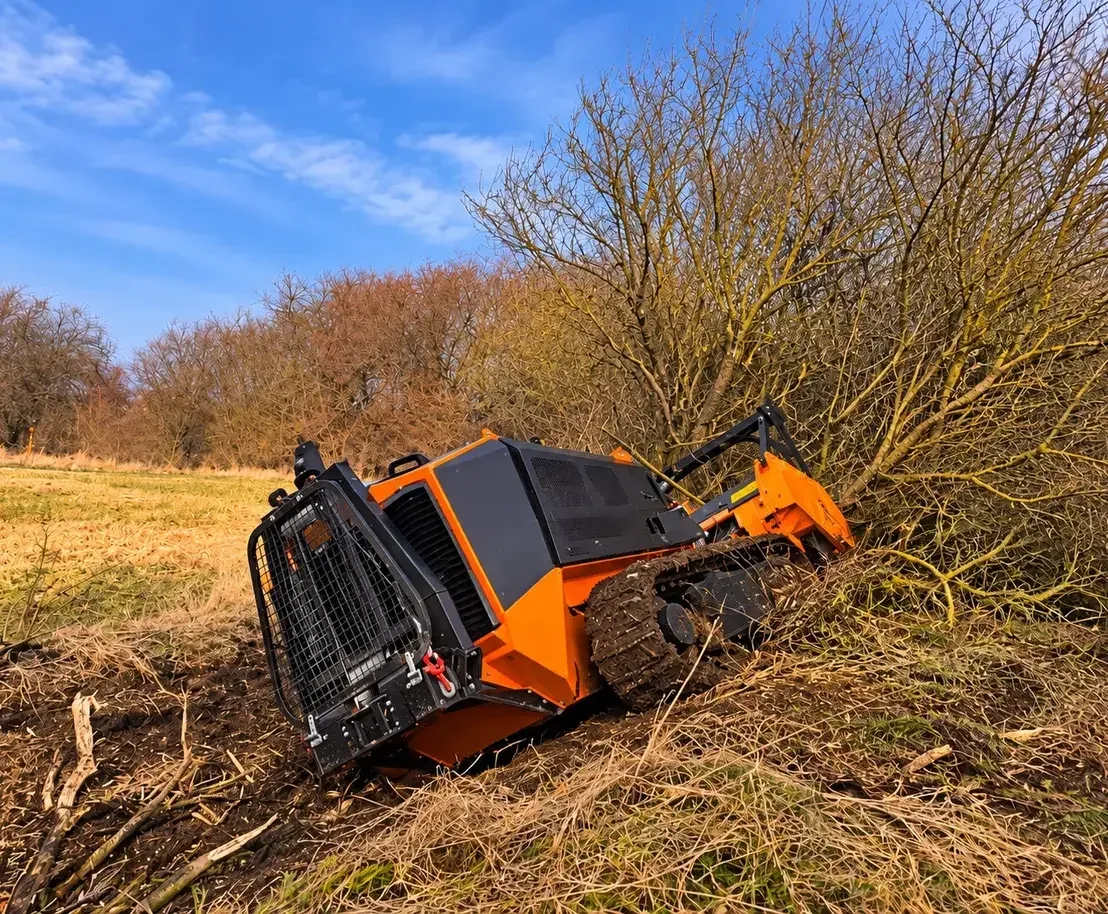
Choose clearance to suit the site, not a machine name
Machinery can process vegetation faster on a continuous, accessible area. Manual work often makes sense beside fences, buildings, valuable planting and narrow spaces. The two methods are frequently combined. Read our comparison of mechanical mulching and manual clearance.
Processing woody material in place can reduce loading and transport where leaving it suits the intended use. It is not an automatic saving for every plot. When commissioning vegetation clearance, confirm the scope, manual finishing and condition at handover in advance.
Removing above-ground vegetation does not remove all roots. Mechanical milling can also address small stumps by agreement; larger stumps and root balls need separate assessment.
Decide which stumps actually need removing
A stump at the edge of a plot may have a different priority from one in a future path or foundation. Routine mowing needs a safe surface; construction needs the ground specified by the design.
Stump grinding processes the agreed part of the wood below the surface and usually disturbs the surrounding area less than excavation. Root-ball extraction needs working space and a plan for the resulting hole. Distant roots may remain afterwards. Compare the options in our guide to stump removal.
Assess the exposed ground before working the soil
Only after clearance can you see the actual ground surface. Further work might include breaking up the topsoil, dealing with woody debris or preparing stony ground. Soil composition and moisture, stones, roots and machinery access all influence the choice between a rotavator and a soil mill.
In suitable soil, GREON describes its rotavator as capable of processing smaller roots up to roughly 5 cm in diameter. This is an indicative capability for particular machinery and conditions, not a guarantee for every root. The scope of soil preparation is therefore confirmed for each site. Underground services and unknown obstacles must be addressed before disturbing the ground.
Land shaping and lawn preparation are further stages
In a garden, the shape of the surface, its relationship to surrounding areas and drainage all matter. Site levelling does not automatically mean creating a horizontal surface: the gradient needs to suit the intended use.
After clearance at these apartment buildings, we shaped the ground for planting and turf. See the work in progress at Modřany ↗
Depending on the soil, screening can remove stones from approximately 2 cm upwards. Moisture, material composition and the machinery used affect the result; removal of every stone is not guaranteed. Suitably prepared ground can then be used to establish a lawn from seed or turf. Both options need watering and aftercare.
Five things to prepare for a quote
- The location and approximate area. Include the working boundary or a simple sketch.
- Overview photographs and close-ups of the vegetation. Identify trees and shrubs to retain.
- A photograph of the access. Include the narrowest point and any terrain restrictions.
- The intended use. Explain what you want the completed area to become.
- Material-handling requirements. What can stay, what must be removed, and whether stump work is required.
Clearance is priced according to the actual conditions, access and agreed result. The GREON price guide gives an indication of follow-on service rates; it does not replace a clearance quote. Before working on trees or shrubs, check the required documents and permission procedure. The name of the method used does not change these requirements.
Frequently asked questions
I have bought an overgrown plot. What should I do first?
Decide how you will use it, record the vegetation and access, and check the conditions for working on trees and shrubs. This establishes the clearance scope and any follow-on work.
Will mulching remove all the roots too?
No. Processing above-ground vegetation does not remove the entire root system. Small stumps can be included in agreed milling work; larger stumps and root balls are assessed separately.
Does all the woody material have to be taken away?
Not necessarily. Where the conditions and intended use allow, some material can be shredded and retained. Agree the quantity, location and handling method beforehand.
Related service
Explore the related GREON service →
Sources and further information: GREON: land and vegetation clearance, GREON: groundworks and site preparation, Czech Public Administration Portal: tree-felling permission. Checked on 30 October 2026.
Prepared by the GREON team. We choose the method to suit the site, access and agreed finish. AI-generated illustrations are clearly distinguished from original GREON photographs.


