
Break preparation into stages: boundaries and documents, vegetation removal, stumps and roots, then groundworks. Define the outcome and responsibility for each.
First mark the intended layout and what will remain
Identify the building footprint, future access, working space and garden separately. Each may need different work. Clearly mark the working boundary and retained trees; tree protection should also account for vehicle movements and material storage nearby.
Before working on trees and shrubs, check the required documents and permissions. Owning the plot does not by itself mean that all vegetation can be removed. Give the contractor the design requirements before pricing.
Check access and utilities before starting
- Measure the entrance and describe tight turns, bridges and unloading space.
- Mention wet ground, slopes and routes with limited load-bearing capacity.
- Provide known information about utilities and their protection zones.
- Mark wells, inspection chambers, old foundations and known areas of made ground.
- Agree who will arrange any further checks on utility locations.
What cannot be seen through vegetation may not be visible in a photograph either. Resolve unknown obstacles before disturbing the soil.
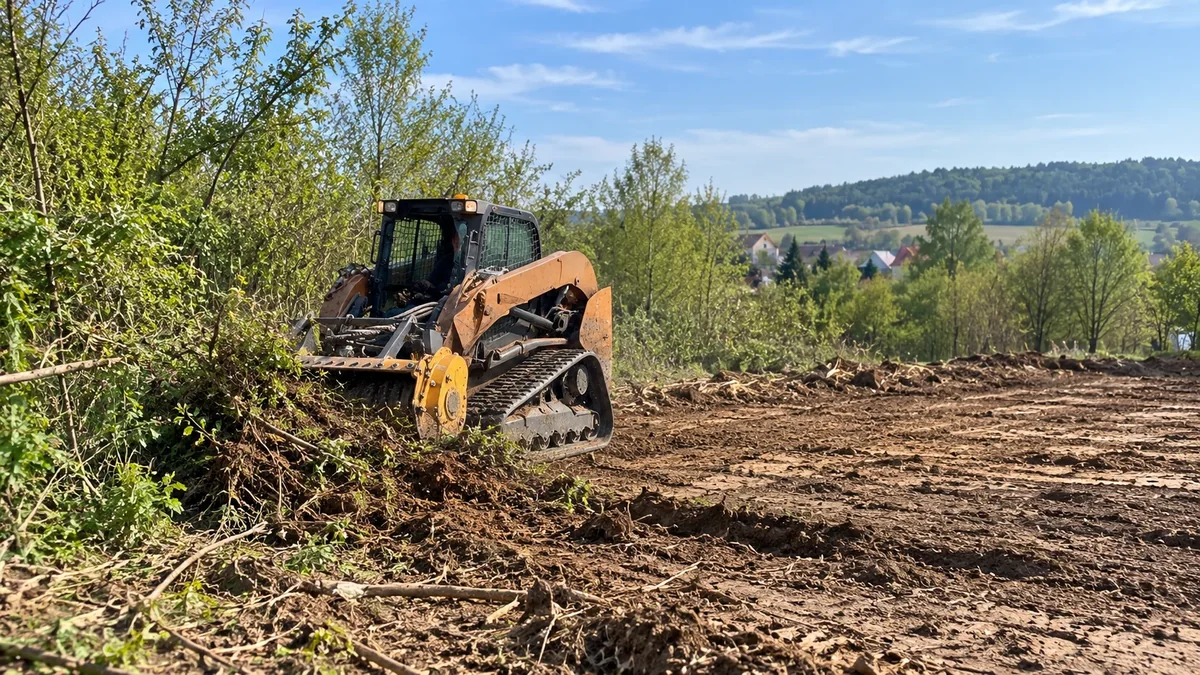
Separate vegetation, timber and root-ball work
The first stage may involve mowing, manual cutting or mechanical clearance. Once the surface is exposed, stump numbers and ground condition are easier to assess. Timber processing, waste removal and removal of agreed parts of stumps or root balls can then follow.
Remaining organic material cannot automatically be treated as suitable ground for a structure. The design and professional assessment determine what needs removing and replacing. Grinding a stump and extracting its root ball produce different results.
Consider levels and drainage together
Rough preparation for construction and the final finish of a garden are different briefs. Soil suitable for a lawn may not meet the requirements of a compacted road base. Simply smoothing visible bumps is neither a drainage design nor confirmation of load-bearing capacity.
This housing project shows the progression from prepared soil to turf beside the terraces. Site preparation at Modřany ↗
For groundworks, provide finished levels, the required landform and how it meets adjoining areas. The quote should specify shaping, soil movements, imported or exported soil, and the condition for handover to the next contractor.
Information that helps coordinate the stages
- The location, area and a sketch of the working boundary.
- Current photographs of vegetation and the access route.
- Trees and shrubs to retain, known utilities and obstacles.
- Requirements for stumps, roots, timber and removal from site.
- Design requirements, finished levels and contractor coordination.
Confirm the scope and handover process for each stage. This avoids commissioning vegetation removal while expecting a fully prepared building site.
Frequently asked questions
Is a plot ready for foundations once vegetation has been cleared?
Not automatically. Ground preparation, root removal, earthworks and any material replacement are determined by the design and professional assessment.
Must every stump across the whole plot be extracted?
The scope depends on how each area will be used and the design requirements. A building foundation needs a different result from a garden boundary.
When should the garden receive its final levels?
In coordination with construction and earthworks. Agree the finished levels and the condition required by the next contractor beforehand.
Related service
Explore the related GREON service →
Sources and further information: GREON: groundworks and coordinating the stages, Czech Public Administration Portal: documents for tree-felling permission. Checked on 30 October 2026.
Prepared by the GREON team. We choose the method to suit the site, access and agreed finish. AI-generated illustrations are clearly distinguished from original GREON photographs.


